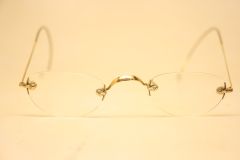
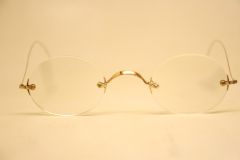
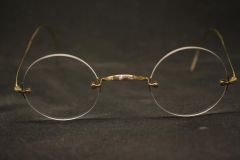
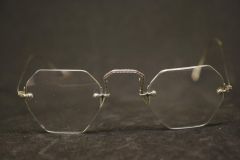
1920s - 1940s glasses
Overview
During the decades between 1920 and 1940 there were some major changes in the world of eyeglasses in general, both in style and in technology. These changes caused some major shifts in the way eyeglasses evolved and deserve some discussion. We will attempt to address the changes that occurred to 1920’s - 1940s glasses frames for both men and women.
Changes to nose pads on 1920s Glasses
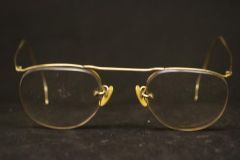
One of the major changes was the invention of nose pads as we know them today in the 21st century. Prior to the 1920s glasses were held on the face with what is called a saddle bridge. Similar to the way a saddle sits on a horse, saddle bridge nose pads sit on the nose and curve around it.
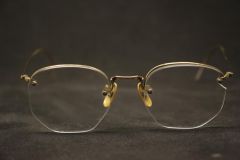
Sometime in the 1920s eyeglasses started appearing with separate detachable nose pads as we know hem today. Made of mother of pearl or various plastics, they were riveted or otherwise connected to the antique frames with various methods of intertwining mechanisms. Screwing the nose pads in as is common today had not yet been invented.
Separate detached nose pads brought about yet another change to 1920s - 1930s glasses frames. The frames could now be much wider and still settle nicely on the nose. With a saddle bridge the frames had to be worn close to the face so that they would settle nicely in the nose. The average frame size of 1990’s was between 4 1/4 - 4 5/8 inches wide, measuring total frame width. Nose pads on 1920’s and 1930s eyeglasses removed this limitation and frames were now made much wider. The average pair of 1920’s - 1940s eyeglasses for both women and men was 4 1/2 to 4 7/8, an expansion of about a quarter inch on average from 1900’s and 1910s antique glasses frames.
Etchings and engravings - Art Deco Glasses
Another change to 1920s glasses that came about due to technology was the emergence of beautiful and detailed etchings and filigree on the temples and front of 1920s and 1930s eye glass frames. Many of these with beautiful styles and etched patterns, known today as Art Deco glasses. Others with beautiful floral designs.
During the 19th century glasses had to be hand engraved for any designs. This was labor intensive and expensive, and therefore uncommon. Once the manufacturing technology to mass produce these processes came about in 1920’s to 1940s eyeglass frames there was now a whole new dimension of design and character to vintage glasses. To use the term Art Deco glasses means you can define these vintage eyeglasses frames not only by their outer shape and dimensions but by there “print” as well, something that was unheard of with 19th century eyeglasses.
Vintage men’s Glasses and vintage women’s glasses
The emergence of etchings and engravings on vintage glasses brought about another change to vintage early 1900s eyeglasses. The beginning of gender distinction in vintage eyeglasses. In the 19th century glasses had been largely unisex with the emergence of patterns and designs that all changed. There were differences between 1920s mens glasses and 1920s womens glasses
There were now men’s vintage glasses and women’s vintage glasses, all based on the perceived masculinity of femininity of the detailed etched pattern.
Changes to nose pads on 1920s 1930s Vintage Eyeglass Frames
Partially connected to the ability to easily etch designs and patterns on these antique eyeglasses was the technology to easily carve out various detailed designs to the nose bridge on these 1920’s - and 1930s vintage eyeglass frames. Nose bridges now had a personality of their own and were no longer a flat and rounded surface. The different vintage eyewear manufacturers each had their signature nose bridge on their vintage glasses frames. You could easily tell the difference between the nose bridge from classic Bausch and Lomb eyeglass frames (B&L) to the nose bridge on a pair of American Optical (AO) Artcraft, Or Shuron.
Vintage eyewear brands
The differences in the engravings and the the detailed nose bridges brought about another unintended consequence to hear vintage eyeglass frames. Eyeglasses could now be easily traced back to their brand. If you had a good eye for detail you could easily tell apart American optical frames from shuron frames or Bausch and Lomb Glasses. There were then loyal Artcraft Fans And COC eyeglass loyalists. If antique eyeglasses have personality and are not just commodities, it follows that many people find themselves drawn to a certain brand and buy only their vintage frames.
Shapes of WWI to WWII glasses
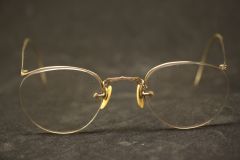
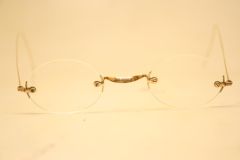
There were a few basic shapes to antique glasses during the 1920’s to 1940’s period. Or roughly the period between world was 1 and world war 2. Prior to the 1920s spectacles had been largely round or oval. There were some rectangular or even octagonal civil war glasses frames during the civil war and later in 1870’s and 1880’s frames but the majority of vintage frames during the 19th century and early 20th century were oval or round glasses frames.
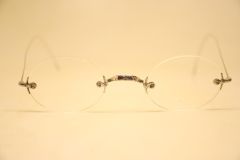
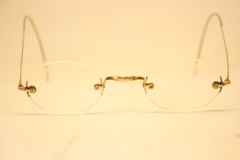
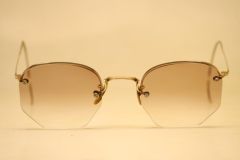
Many 1920s - 1940s style eyeglasses were round or octagonal. Rimless vintage eyeglasses from the early 1900s were often octagonal in shape. The oval shape all but disappeared between the 1920’s and 1940’s. Perhaps the world got bored of 200 years of oval.
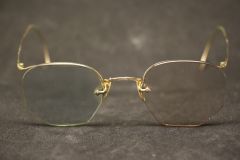
Starting from Around WWI to WWII glasses there was a new shape on the scene. The P3 shape. Named after a model of military issue vintage glasses frames this shape became beloved by many and left its roots until today. Oddly enough this shape hadn’t really been thought of beforehand. It has the appeal of round without it’s impracticalities. This all came about with the emergence of ful-vue glasses.
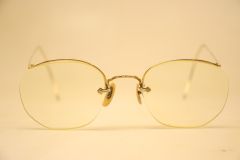
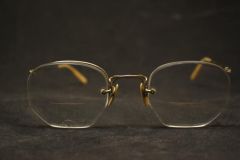
Another shape nd style that came around at that period, was semi rimless glasses, also know as numont or rimway glasses. These were rimless glasses with a thin wire on top andd behind the lenses, enabling a quality frames structure with a rimless frame look.
1920s Sunglasses, 1930's Sunglasses and 1940s Sunlgasses
Another interesting development of this era was the development and evolution of vintage sunglasses. During the 1920s sunglasses were "invented" in their modern sense as a popular fashion accessory. Foster and Grant was one of the earlier companies popularaizing 1920s and 1930s sunglasses on the Beaches of Atlantic City. By 1937 20 million sunglasses had been sold. Polarized sunglasses also started in the 1930s but continued mainly with 1940s sunglasses.
Interestingly, we don't find many prescription 1920 sunglasses. It is quite possibly that the popularity of vintage prescription sunglasses only started becoming popular later, with 1940s sunglasses. Perhpas people wearing 1920s and 1930s sunglasses were happy to protect their eyes from the sun without the need to also see well through them. Only later did the 2 become more cloesly correlated.