
Gold filled glasses; What are they and why aren't they made anymore?
1. Introduction
One of the most common questions we get about antique eyeglasses is what material they are made of? Are they solid gold, gold filled, or just gold colored? What are gold filled glasses, and are they the same thing as gold plated?
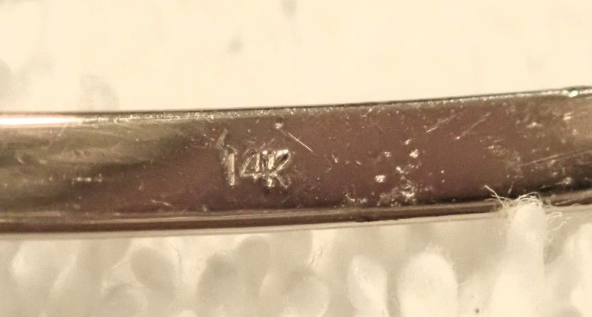
Many vintage eyeglass frames are marked 1/10 12k gold filled, others are just marked G.F. while others are not marked at all. These markings are generally stamped on the temples or under the nose bridge on vintage gold filled glasses. Sometimes silver colored frames are marked as gold filled causing confusion to some as to the gold content of these silver tone vintage eyeglasses.


Today it would seem inconceivable to manufacture eyeglasses out of real gold. You do hear of some companies selling solid gold frames for $18,000 here and there but it is certainly not common and definitely not on most frames as with vintage eyewear.
1/10 12k gold means that the frames are 10 percent of 12 karat gold, or 5% of solid gold which is 24 karat. 1/10 12k was the most common type of gold filled glasses made in the US. In the United Kingdom and elsewhere in Europe frames were often made of 1/20 10k, which is 5 Percent of 10 karat or about 2 percent of 24 karat solid gold.
2. Solid Gold eyeglasses
In addition to gold filled glasses, vintage frames were often made of solid gold. The most common material was 10 karat gold, which was often used with frames in the late 1800's and early 1900's eyeglasses. The hallmark for antique 10k eyeglasses is a circle with
a line going through it's center. This mark is often found on vintage glasses under the nose bridge and / or on the temples near the screws where they connect to the front of the frames. 14k solid gold frames were also common, with a 14k hallmark marked on the temples or under the nose bridge.
3. 10k Pads vs 10k gold
In some "newer' antique eyeglasses frames, eyeglasses from 1920 or 1930 when nose pads were common already, frames were often made of other metals or even gold filled, but the nose pads were made of solid gold. The nose pads on these 12k eyeglasses were often marked 10k pads or 14k pads, meaning that just the nose pads were solid gold, 10k or 14k gold.
4. Why they stopped making them
To fully understand the reason why there are no more gold filled glasses made these days, a little history of gold and it's relation to currency is neccasary.
Gold was always scarce and always considered a precious metal. But is was not until about 643 BC that it was used as a currency.
In 1971 President Richard Nixon officially abandoned the gold standard in the US. Now that the dollar was no longer linked to gold the price of gold shop up to $120 an ounce from its prior $35 per ounce trading price. Understanby it stopped being a meterial to be used for eyeglasses or other relatively inexpensive accesorries.
5. Gold filled glasses vs gold plated eyeglasses
Many people ask us, what is the difference between gold filled glasses and gold plated eyeglasses? As explained above, gold filled is a heavy plating process where 5 to 10 percent of the eyeglasses are real gold.
Gold plated on the other hand is a very light coating, often 100 times less than gold filled eyeglasses. The gold plated coating is very inexpensive as it has little actual gold content and therefore is common today on eyeglasses as well as on many other types of jewelry.
Another type of gold filled eyeglasses is called rolled gold plated, or RGP. The vintage eyglass frames usually had much less gold content, often 1/30 10k. or so, so the value was much lower.
6. The benefits of gold filled eyeglasses
The benefits of gold filled eyeglasses are many. For starters, the material is very strong and of great quality. Gold is one of the only metals that are rust proof, so 12k glasses are essentilly rust proof. It will last much longer than gold plate or just gold colored eyeglasses which can wear off more easily.
Aside from that there is no question the appeal and allure of real gold vintage eyewear is much greater than of other inexpensive materials. It is like the difference between solid gold jewelry and fake jewelry. People feel much better knowing that are wearing something solid.
Furthermore, 12k eyeglasses retain some of their value forever. If you buy a pair of plastic vintage glasses
and they are worn out or broken after a few years, the glasses are then virtually worthless. Not so with vintage glasses. A broken and twisted pair of 1930's vintage gold filled glasses is still worth about $20 in scrap gold. There are people who specialize in melting down these vintage eyeglass frames and getting out the gold content to sell from scrap, to be reused and upcycled. You won't find that with todays eyeglasses materials.
Gold filled glasses can also benefit some people are allergic to certain types of metals. It can cause them skin irritation or other ailments. Gold filled eyeglasses can help with some of those conditions for some people.
7. Types Of Gold Filled Glasses
Many pince nez glasses were gold filled or solid gold. Many spring bridge pince nez glasses were gold filled or solid gold. Hard bridge pince nez were generally gold filled. Oxford Pince nez were often 1/10 12k gold filled or solid gold. Sometimes only the spring on oxford pince nez was gold, with the rest of the frames being of a less precious material.
Many cat eye glasses as well as other types of 1960's eyeglasses were made of 1/10 12k gold filled material. On some frames it was just the chasis, the front part that held the lenses, while the rest of the frames were aluminum or plastic, but some cat eye frames were entirely gold filled 1/10 12k or 1/20 10k or 12k.
Cable temple wire rim glasses were often made of 1/10 12k gold filled or solid gold. Same goes for windsor glasses, though those were usually not solid gold. John Lennon's glasses were likely gold filled
Vintage Rimless eyeglasses, Semi rimless Numont eyeglasses and marshwood eyeglasses were often gold filled. The silver ones were often white gold filled, almost always 1/10 12k.
Gold filled eyeglass frames as well as solid gold eyeglasses stopped being manufactured after the rise in the price of gold in the 1970's.
8. Value of gold filled eyeglasses.
How much are gold filled eyeglasses worth? The price of a pair of gold filled eyeglasses in good condition can be $100-$300. This takes into account the fact that they are being used as prescription eyeglasses and should last at least a few years. Vintage eyewear was well made and was built to last.
To understand the value of broken or unusable gold filled glasses we must first take into account the price of gold on that given day. Let's use a price of $1200 per ounce as an example. Being that we have 12 karat gold, the value is only $600 per oz. Now we must divide this number by 10 since we only have 1/10 12k material, only a tenth of the eyeglasses are 12k gold. That comes out to $60 an ounce. A pair of gold filled eyeglasses generally weights 0.3 - 0.5 oz after removing the lenses, nose pads, and non gold filled screws. So at $1200 an ounce each pair would be worth $12-$19 in melt value.

We must also take into account wear and tear that can occur to the frames over the years which can reduce the gold content. Some gold filled eyeglasses were kept in better condition and retained the full gold content while others are extremely worn and much of the gold filled content has rubbed off.
Gold today is worth $1284 an ounce. At its peak in 2011 gold was worth $1895 per ounce. So in short the value of gold filled eyeglasses is directly tied to the value of gold on any given day.
Being that the price of gold fluctuates minute to minute, the person purchasing the 12k glasses must take into account the fact that by the time the frames arrive in the mail the value may be less, they may want to allow some more room in the price they pay to account for that.
9. Value of solid gold glasses
The value of solid gold glasses is directly linked to the price of gold. Using the same $1200 per oz example, vintage eyeglasses made of solid 12k gold would be worth $600 an oz. A pair of solid gold antique spectacles from 1850 would weigh somewhere around 0.3 oz so the melt value would likely be somewhere around $120. A pair of Windsor eyeglasses made of solid gold would be heavier and weigh closer to 0.6 oz so the gold value would be closer to $250. A pair of gold filled rimless 1900's eyeglasses or a lightweight pair of pince nez glasses would likely weigh around 0.1 or 0.2 oz so the value would be $40 -$80 per pair.
Of course this is only referring to the actual melt value. A pair of solid gold riding temple antique eyeglasses would only be worth $120 in gold value but due to it's rarity and appeal would likely sell for $200-$300.