
Antique spectacles: history and evolution over the past 700 years.
1. The Inventor of Antique Spectacles
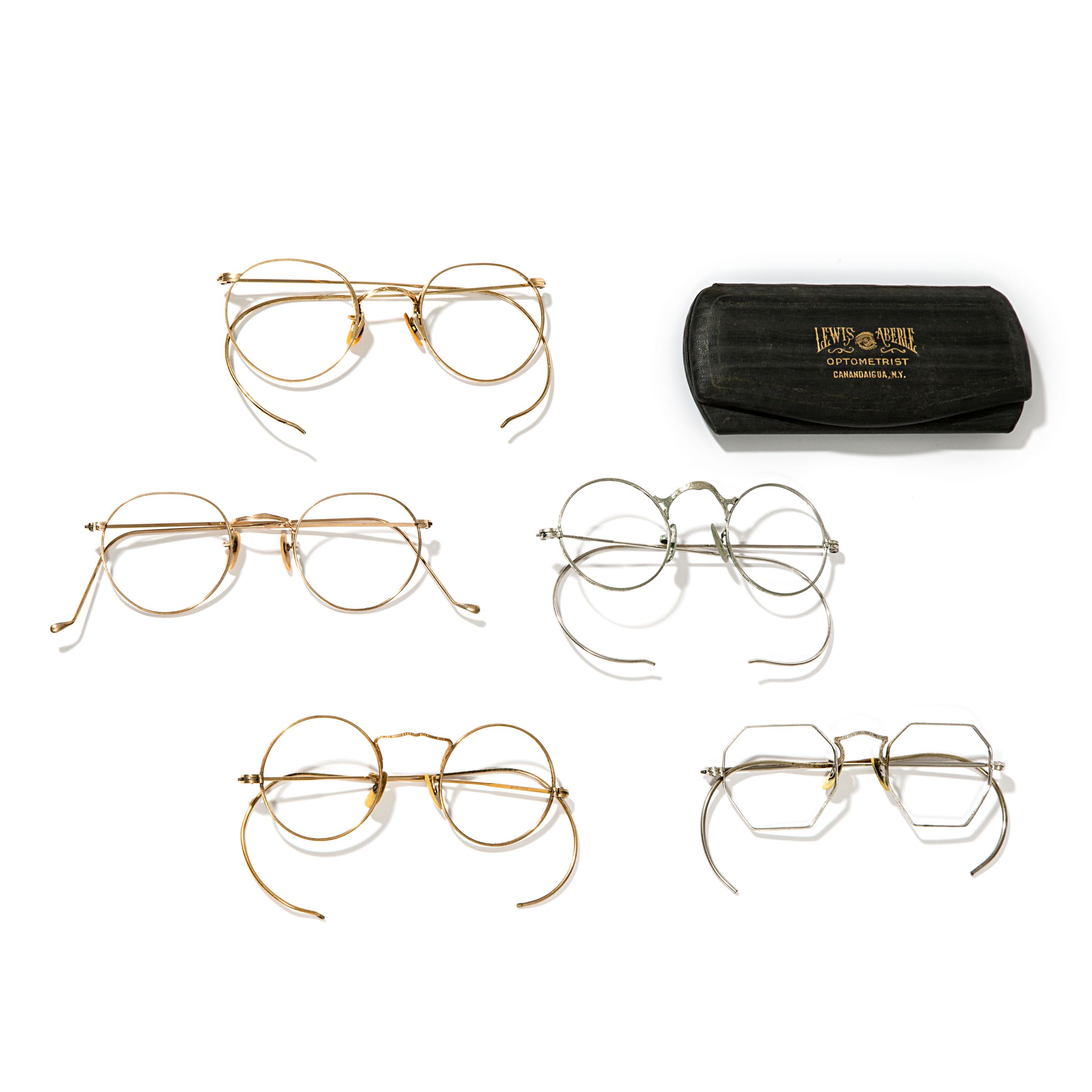
The history of antique spectacles is shrouded in mystery. It’s inventor and era of origin are not very clear. Some may have heard that Benjamin Franklin invented antique spectacles. The reality is that antique eye glasses were around for a few hundred years before Benjamin franklin was born.
What benjamin franklin invented was bifocals, the ability to have 2 different prescriptions on in a pair of eyeglasses. This would help himself and all others suffering from both myopia and presbyopia. One for nearsightedness and one for farsightedness. Interestingly enough what they did at the time was simply glue a small and thin lens piece on the lower part of an existing lens, or put together two halves of different lenses within each lens rim of antique spectacles. This seemingly isn’t much of a feat. Only 70-80 years ago did they figure out how to make bifocals out of one piece of glass. And even then there was still a visible separation between the two parts. Only recently did they get better at making the transition between both parts of the lens more seamless.
While bifocals are a great invention, this is not the origin story of antique eyeglasses.
So who was the true inventor of antique spectacles.
2. Precursors to antique spectacles
There is some evidence of the use of glass visual aides during Roman and Greek times. Pliny the Elder writes of such use by Emperor Nero.
Ptolemy writes about the use of optics to enlarge items, as well as the Arab Mathematician, astronomer, and physicist Alhazen known as the father of optics.
De iride by Robert Grosseteste written between 1220 and 1235 refers to the use of optics to "read the smallest letters at incredible distances”.
In 12th century China they would use quartz stone to protect the eyes, though this likely did not have any corrective value. The Inuit are said to have developed the first “safety glasses” to protect the eyes from the snow.
In the Viking age they would grind lenses out of rock crystal. It is unlikely that these had any corrective nature and were likely decorative only.
But can these be called spectacles?
To answer the question of who invented antique spectacles we really need to ask: What do we mean by antique spectacles?
It is clear that we must distinguish between magnifying glasses / telescopic lenses and more recent antique eyeglass frames worn on the face.
So who is to take credit for antique frames as we know it?
3. The real Inventor of Antique Spectacles
Professor Berthold Laufer in his book on the history of glasses puts the invention of antique eyeglasses to somewhere in India.
Italian explorer and writer Marco Polo is claimed to have discussed seeing spectacles in 13 century China. This is not mentioned in his writings though, and can therefore not be trusted.
The earliest documented account have antique spectacles in China some 20 years later, and these were imported from other countries.
Some point to a 13th century Italian named Salvino D’armati of Florence.
This has been widely disproven.
Others credit Roger Bacon, who was based in Paris, who in the mid 13th century wrote a book one the principles of vintage glasses called Opus Majus. It is pretty clear though that he never actually created physical eyeglass frames.
Various Venetian guild bylaws from 1284-1301 refer to the concept of vintage spectacles and reading glasses
Many believe that spectacles as we know it were invented in Italy in the late the 13th century in Pisa or nearby in the Venice area. Dominican friar Giordano de Pisa in a 1306 speech is quoted to have spoken of meeting the inventor of antique spectacles, a new invention that was not even 20 years old.
According to records from that time, it was his colleague Alessandro della Spina of Pisa who popularized spectacles and made them publicly and widely available, after the original inventor did not want to share his invention of antique eyeglasses with the wider public.
The truth seems to be that the invention of antique spectacles was not a one time discovery by one person, but rather an evolution of many years of knowledge and many people perfecting the work of others until the final product came to be. From someone noticing that convex shaped glass can make things larger to other figuring out how to grind lenses that would accomplish other visual feats until eyeglasses as we know it came into being.

4. Antique Spectacles in art
The first known appearance of spectacles in art is in a 1352 portrait of the cardinal Hugh de Provence reading in a scriptorium. Painted by Tommaso da Modena's. Interestingly, the person depicted in the painting died in 1260 and could not have been wearing antique spectacles as they likely hadn’t been invented yet.
Another early example would be a depiction of eyeglasses found north of the Alps in an altarpiece of the church of Bad Wildungen, Germany, in 1403.
5. Evolution of frame structure in antique spectacles
The story of the evolution of spectacles is the story of overcoming one challenge: keeping vintage eyeglasses comfortably on the face. From it’s early invention until today manufacturers and inventors are trying to come up with the best way of keeping antique eyeglasses on one’s face. Until not long ago the methods for doing so seem to be quite archaic. Who knows if today’s current method is the final one? Perhaps there will be better and more comfortable method yet to be thought of.
6. Antique spectacles in the 1400’s1600’s:
The earliest Antique Spectacles that have survived until today are some 15th century Rivet Eyeglasses. Each lens had a handle, and the handles were riveted together at the end allowing them to fold. Here we see Vintage eyeglasses in their rawest form with no mechanism to keep them on the face.
With the invention of the printing press and with the popularity of books growing with the masses during the 1500’s and 1600’s the demand for vintage frames rose, and a commercial industry arose with artisans manufacturing them and peddlers going around and selling the newly invented vintage eyeglasses. They were a hot commodity as people begun to learn that they could indeed improve their vision. Eyeglass frames at the time were made mainly of leather and metal wire.
A mini industry for eyeglasses started to develop around Nuremberg, Many of these frames survive until today and are widely known as Nuremberg spectacles.Germany remained the capital of manufacturing for antique spectacles until the 1600s.
The Popularity of antique spectacles rose even further after newspapers became popular in the late 1600’s. Spectacles started becoming a status symbol representing intelligence, class and upper society. Thus started the trend of wearing eyeglasses even when not needing them for improved eyesight.
As mentioned earlier the earliest antique spectacles were handheld rivet eyeglasses, which were handheld. This was followed by bow specs with an arched round bridge, followed by slit bridge and nuremberg spectacles, which made the bridge more flexible. Bear in mind this is before the invention of pince nez and temple spectacles when they figured out how to keep eyeglasses on the face, these were still handheld.

7. The Invention Of temples Antique spectacles
The first pair of spectacles with temples were invented in the UK in the early 1700’s, likely by a man named Edward Scarlett. These had short temples with a large loop at the end and pressed against the face which is what kept them on, not going past the ears. In the mid 1700’s they improved this design and started making the temples longer, often with another hinge for the extended part. These are sometimes called double hinge spectacles due to the 2 hinges found on each temple.
Temples were a great improvement to earlier vintage eyewear, which simply balanced on the nose or were handheld.
8. Turn Pin Eyeglasses
There were various tweaks and offshoots to Antique spectacles once temples were invented. One such type is called Turn pin eyeglasses. Invented in the mid 1700’s, rather than double hinges these had a rivet mid temple with an extra piece attached, effectively creating an extension to these antique spectacles. The extra part would slide sideways and generally had a tear drop end, thus the term Turn Pin.
9. Sliding Temple Spectacles
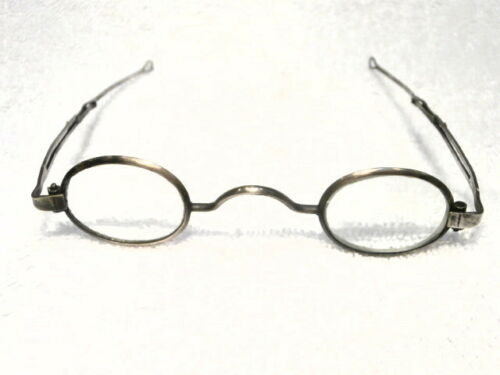
Perhaps the most popular version of the early temples on antique spectacles are sliding temple spectacles. These had a temple that was able to be extended back while wearing and retracted while storing them so they could fit in the case. Sliding temple spectacles were common from the 1760's until the 1880’s. This type of spectacle stayed in place better than straight temples and this design remained popluar for over 100 years, making them much more common today.
Sliding Temple Spectacles were generally made of stell, though they were also made of coin silver or solid gold.
10. Four Lens Spectacles and Antique Sunglasses
During the late 1700’s another type of antique spectacles was invented: Four lens eyeglasses. The first type of these frames had 2 additional lenses on hinges on top of the lenses which could be rotated down when necessary to help strengthen the prescription for up close viewing of objects.
The next version of four lens spectacles had the hinges on the outer edges of the lenses so that they could be rotated sideways when doubling of the lenses was needed.
When rail travel became popular at first they didn’t have enclosed carts, which made for a windy and dusty ride. Four lens spectacles were thus repurposed to be used as “safety glasses” to block out the dust and wind. The shape of the lenses was often the shape of the letter D instead of oval lenses so that they would fully block the corners with the two back od the D’s to each other. This type also beca
The idea of side visors on eyeglasses grew out of the four lens spectacles.
11. Martins Margins Antique Spectacles
In 1756 London Optician Benjamin Martin Came up with a new theory: Increased exposure to light could damage the eyes. Based on this theory he proposed adding a thick round horn rim “margin” inside existing frames and just around the lenses which could then be reduced by about a third, which would help prevent all this light from coming in. These frames have an extremely distinct look. These remained popular for about 50 years and were known as Martins Margins.
12. And then, back to Pince nez.
As with everything, life is cyclical. Hundreds of years after they were first invented, antique spectacles without temples became popular again. This time in the form of pince nez. Pince Nez was a great improvement to the original ones that balanced wobbly on the face. This time they were spring loaded and figured out how they could be kept sturdy and comfortable on the face. These frames were pupular from the mid - late 1800’s until the early 1900’s, and went out of vougue before WWII.